

If you’ve ever stared at a shoebox full of receipts and wondered, “Is this… bookkeeping?” — you’re not alone. Every business, from a one-person Etsy shop to a growing agency, runs on the same backbone: accurate financial records. But not all bookkeeping looks the same.
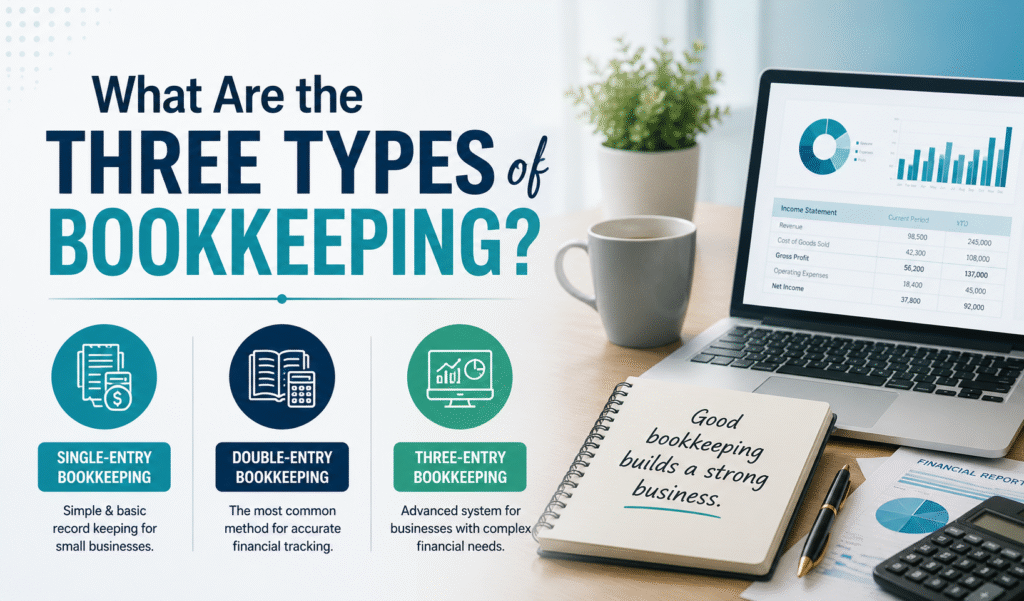
There are three core types of bookkeeping — single-entry, double-entry, and computerized (cloud-based) bookkeeping. Each one fits a different stage of business. Choosing the wrong option can lead to expensive consequences, money, and tax headaches down the road.
This guide breaks down all three in plain English so you can figure out which one your business actually needs — and when it’s time to bring in professional bookkeeping services or a chartered professional accountant.
What Is Bookkeeping, Exactly?
Bookkeeping is the ongoing process of recording every financial transaction your business makes — sales, purchases, payroll, and expenses — so you always know where your money is going.
It’s not the same as accounting. Bookkeeping is the data entry and recordkeeping layer. Accounting is the analysis, tax strategy, and reporting built on top of that data.
The IRS actually requires businesses to keep records that support the income, expenses, and deductions reported on a tax return, per IRS Publication 583, Starting a Business and Keeping Records. So bookkeeping isn’t optional busywork — it’s a legal requirement tied directly to how you file taxes.
What Are the Three Types of Bookkeeping?
Single-entry, double-entry, and automated (cloud-based) bookkeeping are the three primary forms of bookkeeping. They differ in how transactions are recorded and how much detail — and protection against errors — they offer.
Here’s how each one actually works.
1. Single-Entry Bookkeeping
Single-entry bookkeeping records each transaction just once, as either income or an expense — similar to keeping a checkbook register.
It’s simple. It’s fast. And honestly, it’s fine for very small operations with low transaction volume, like a solo freelancer or a hobby-turned-side business.
The catch: Single-entry bookkeeping does not track assets, liabilities, or equity. It only records what was received and what was spent, which makes it difficult to produce a balance sheet or identify data-entry errors, as there is no second entry to verify against.
Think of it like a diary of your money — useful, but limited.
2. Double-Entry Bookkeeping
Double-entry bookkeeping records every transaction twice — once as a debit and once as a credit — so your books always stay balanced.
This is the method most established businesses and accountants use, because it’s self-checking: if the debits and credits don’t match, you immediately know something’s wrong.
Double-entry bookkeeping isn’t a modern invention, either. Italian mathematician Luca Pacioli formally documented the method in his 1494 work Summa de Arithmetica, Geometria, Proportioni et Proportionalita — often cited by accounting historians as the first published description of double-entry accounting. Over 500 years later, it’s still the industry standard.
Double-entry bookkeeping lets you produce a full set of financial statements: income statement, a balance sheet, and a cash flow statement. That’s why lenders, investors, and tax authorities generally expect to see it once a business grows past a certain size.
3. Computerized (Cloud-Based) Bookkeeping
Computerized bookkeeping uses accounting software to automate the recording, categorizing, and reconciling of transactions — usually built on double-entry principles under the hood.
Platforms like QuickBooks (Intuit) and Xero are widely used examples. They connect directly to your bank feeds, auto-categorize expenses, and generate reports in a few clicks instead of a few hours.
This is where most small businesses eventually land, because it combines the accuracy of double-entry bookkeeping with software that does the heavy lifting. It’s also the format most bookkeeping services and accounting firms build their workflow around today, since it makes collaboration and real-time reporting far easier than paper ledgers ever could.
Which Type of Bookkeeping Is Right for Your Business?
The right type of bookkeeping depends on your business size, transaction volume, and whether you plan to seek financing or grow. There’s no one-size-fits-all answer.
A brief method to consider:
- Very few transactions, just getting started? In the short run, single-entry might work for you.
- Growing, in need of a loan or actual financial statements? Double-entry is practically unavoidable.
- Want accuracy without doing it all manually? Cloud-based bookkeeping software is the practical middle ground most businesses settle into.
One more factor most owners overlook: your accounting method for tax purposes. Under Internal Revenue Code Section 448(c), businesses above a certain average annual gross receipts threshold (adjusted for inflation) are generally required to use the accrual method of accounting rather than the cash basis, according to IRS Topic 305, Accounting Periods and Methods. That threshold determines a lot about how detailed your bookkeeping system needs to be — which is exactly the kind of thing a chartered professional accountant can help you confirm before it becomes a filing problem.
How Do Bookkeeping Services Help Small Businesses?
Bookkeeping services take the day-to-day recording, categorizing, and reconciling off your plate, so your books stay accurate and audit-ready without eating into the hours you should be spending running your business.
A lot of business owners try to DIY bookkeeping early on — understandable, since budgets are tight. But bookkeeping is one of those tasks where small mistakes compound. A miscategorized expense in January can throw off your quarterly tax estimate, your cash flow picture, and your year-end financials, all from one small slip.
The U.S. Small Business Administration specifically advises new business owners to set up a proper recordkeeping system early, as one of the foundational tasks of starting a business (sba.gov). Clean records allow you to see your profitability rather than merely speculating solely on your bank balance, so it’s not just red tape.
Typical professional bookkeeping services consist of:
- Keeping track of and classifying earnings and outlays
- Reconciliation between credit cards and banks
- Tracking accounts payable and receivable
- Assistance with payroll processing
- Monthly or quarterly financial reports
- Keeping records organized for tax season
Outsourcing this doesn’t mean losing visibility into your finances — good bookkeeping services actually give you more visibility, because the numbers are accurate and up to date instead of a backlog you dread opening.
What’s the Difference Between a Bookkeeper and a Chartered Professional Accountant?
A bookkeeper focuses on recording and organizing day-to-day transactions. A Chartered Professional Accountant (CPA) is a licensed professional who interprets those numbers — handling tax strategy, financial statement preparation, audits, and higher-level business advice.
Think of it this way: a bookkeeper keeps the story accurate, page by page. A CPA reads the whole book and tells you what it means for your business — and what to do next.
The Chartered Professional Accountant designation itself has an interesting history. In Canada, the three legacy accounting bodies — Chartered Accountants (CA), Certified General Accountants (CGA), and Certified Management Accountants (CMA) — unified into the single CPA designation starting in 2013, under the national body CPA Canada. It was one of the biggest consolidations in the profession’s history, designed to create one recognized standard instead of three competing ones.
A CPA typically gets involved for things bookkeeping alone can’t cover:
- Preparing and filing corporate or personal tax returns
- Strategic tax planning
- Financial statement audits or reviews
- Business structuring advice (incorporation, mergers, etc.)
- Representing your business in front of tax authorities
Do You Need a CPA or Bookkeeping Services First?
Most businesses need bookkeeping services first, and bring in a Chartered Professional Accountant as they grow, need tax strategy, or face more complex financial decisions.
Bookkeeping is the foundation — it’s the raw, accurate data. A CPA builds strategy on top of that foundation. Trying to get sound tax advice from messy, incomplete books is a bit like asking a GPS for directions with half the map missing.
In practice, many businesses use both services together: a bookkeeping provider keeps monthly records precise and current, while a CPA manages big-money decisions such as borrowing or restructuring the organization, along with tax-time preparation, filing responsibilities, and yearly forecasting and planning.
Frequently Asked Questions
Does law require double-entry bookkeeping?
Not universally, but most tax authorities and lenders expect financial statements that are only really achievable with double-entry records, especially once a business crosses certain revenue thresholds.
Can I switch bookkeeping methods later?
Yes, though switching accounting methods for tax purposes (like moving from cash to accrual) may require IRS approval in certain cases. A chartered professional accountant can walk you through the process.
How long should I keep bookkeeping records?
The IRS generally recommends keeping records for at least 3 years from the date you filed the related tax return, with longer periods required in specific situations, such as claims for bad debt or worthless securities (IRS Publication 583).
The Bottom Line
Single-entry, double-entry, and computerized bookkeeping all play distinct roles — and many businesses ultimately progress from the first method to the third. The key point isn’t choosing the system that seems most sophisticated; it’s selecting the approach that fits where your company truly stands today and recognizing when you’ve clearly outgrown it.
If your books have gotten messy, or you’re not sure whether you need bookkeeping services, a chartered professional accountant, or both — that’s a completely normal place to be. It’s also exactly the kind of question worth getting a straight answer to before tax season sneaks up on you.
For a deeper look at what bookkeeping services actually include for small businesses, see What Are Bookkeeping Services for Small Businesses?